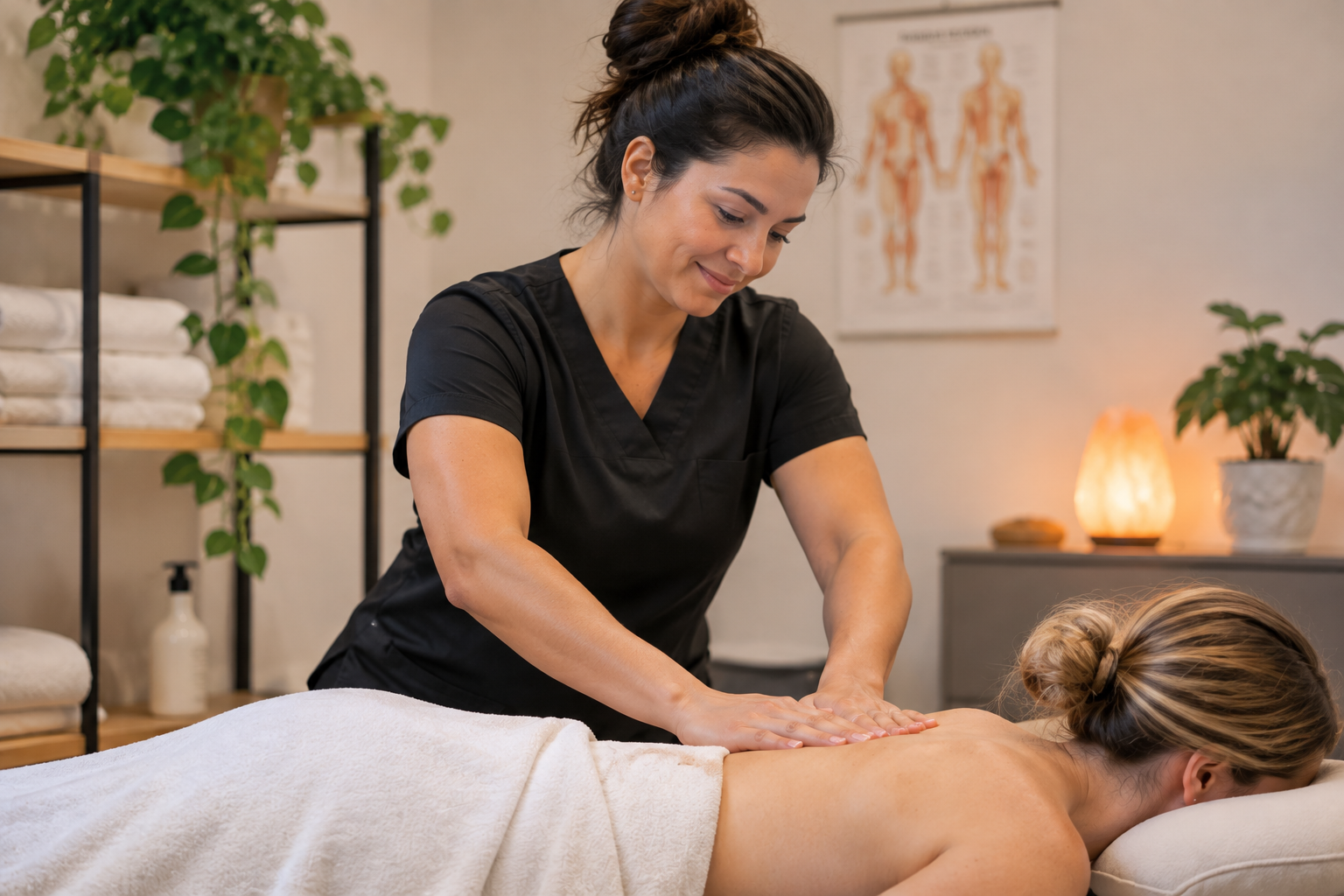
Canada’s 2026 Federal Budget includes welcome news for Registered Massage Therapists (RMTs): a proposed RMT GST/HST exemption in Canada could significantly change how massage therapists manage their taxes.
For many RMTs, this could mean no longer charging GST/HST on treatments. However, there are a few important details to understand before changing your billing or cancelling your GST/HST registration.
The exemption also affects your ability to claim GST/HST on business expenses, and clinics offering retail products or other taxable services will have additional considerations.
Let’s look at what these changes could mean for your practice.
RMT GST/HST Exemption Canada: What Is Changing?
Budget 2026 proposes adding qualifying massage therapy services to the list of healthcare services that are exempt from GST/HST. Currently, most massage therapy services are subject to GST/HST unless another exemption applies. Under the proposed changes, qualifying massage therapy services would become exempt. The proposal would apply to qualifying services supplied after Budget Day, November 5, 2026, subject to the legislation being enacted. Importantly, not every type of massage treatment will necessarily qualify for the exemption.
When Will the GST/HST Exemption Take Effect?
Although Budget 2026 has announced the proposed GST/HST exemption, Parliament has not yet enacted the legislation.
We have seen similar changes before.
In November 2023, the federal government announced a GST/HST exemption for qualifying psychotherapy and counselling therapy services. However, the exemption did not take effect until June 20, 2024, when the legislation received Royal Assent, approximately seven months later.
The proposed massage therapy exemption is slightly different, as Budget 2026 currently proposes an effective date for qualifying services supplied after Budget Day. Whether that date remains in the final legislation is not yet known. Some tax measures move through Parliament faster than others, depending on the legislation and other measures included in the bill.
Should RMTs Stop Charging GST/HST Now?
Our recommendation is that RMTs continue charging, collecting and remitting GST/HST under the existing rules until the legislation is enacted and CRA’s implementation guidance is confirmed.
If you collect GST/HST from clients, you are required to account for and remit those amounts to CRA. You should not simply stop remitting GST/HST because an exemption has been proposed.
If the exemption is ultimately implemented retroactively, there may be adjustments required for GST/HST previously collected and ITCs claimed. For now, we recommend maintaining your existing billing practices and preparing for the proposed changes rather than making changes prematurely.
Does the GST/HST Exemption Apply to RMTs in Every Province?
The proposed GST/HST exemption is federal, but the qualifications required to access it will depend partly on the province where the massage therapist practises.
Currently, massage therapy is regulated as a health profession in five Canadian provinces:
– British Columbia
– Ontario
– New Brunswick
– Newfoundland and Labrador
– Prince Edward Island
In these provinces, massage therapists would generally need to hold the required provincial licence or registration to qualify.
What About Provinces Without a Regulatory College?
Massage therapy is not regulated in the same way in provinces such as Alberta, Manitoba and Nova Scotia. However, that doesn’t mean massage therapists in these provinces are automatically excluded. Budget 2026 proposes that massage therapists practising in provinces without mandatory licensing can qualify if they have qualifications equivalent to those required for licensing in a regulated province.
For example, a massage therapist practising in Alberta may qualify if they have the necessary professional qualifications, even though Alberta does not have a provincial regulatory college for massage therapy.
Membership in a professional association may help demonstrate qualifications, but membership alone should not be assumed to establish eligibility.
The takeaway: The exemption is intended to be available across Canada, but individual practitioners will need to confirm that they meet the qualification requirements.
What Does GST/HST Exempt Actually Mean?
When a service is exempt from GST/HST, you do not charge GST/HST to your clients.
However, there is another important side to this change.
You can no longer claim Input Tax Credits (ITCs) for GST/HST paid on expenses related to providing exempt services.
Previously, an RMT registered for GST/HST could generally recover the GST/HST paid on eligible business expenses through ITCs. Once qualifying treatments become exempt, GST/HST paid on expenses used to provide those treatments generally becomes an additional business cost.</p>
Examples include:
– Massage oils, lotions and treatment supplies
– Treatment tables and other equipment
– Clinic rent, where GST/HST is charged
– Software subscriptions
– Other operating expenses related to exempt treatments
This is an important distinction between exempt and zero-rated supplies.
With zero-rated supplies, GST/HST is charged at 0%, but eligible ITCs can still be claimed. With exempt supplies, no GST/HST is charged and related ITCs generally cannot be claimed.
For RMTs, this means the exemption may simplify billing, but it can also increase operating costs because GST/HST on related purchases is no longer recoverable.
Can RMTs Cancel Their GST/HST Registration?
Potentially, yes!
If you provide only exempt massage therapy services, you may no longer need a GST/HST account once the exemption applies.
However, if your practice also sells products or provides other taxable services, you will need to determine whether you qualify as a small supplier.
What Is a Small Supplier?
For most businesses, a small supplier is a business with $30,000 or less in worldwide taxable revenue over four consecutive calendar quarters, provided it also does not exceed $30,000 in any single calendar quarter. The important word here is taxable.
Once qualifying RMT services become exempt, revenue from those exempt services would no longer count toward the $30,000 small-supplier threshold. However, other taxable revenue still counts, including taxable supplies that are zero-rated.
Example: An RMT Clinic With $170,000 in Annual Revenue
Consider a massage therapy clinic that earns $170,000 annually from three sources:
| Revenue Source | Annual Revenue |
|---|---|
| Exempt RMT treatments | $150,000 |
| Retail product sales | $12,000 |
| Taxable spa treatments | $8,000 |
| Total Revenue | $170,000 |
Although the clinic earns $170,000 annually, only $20,000 comes from taxable supplies. Assuming the clinic meets the other small-supplier requirements, including the applicable quarterly tests, it may qualify as a small supplier and be eligible to cancel its GST/HST registration. This is why it’s important to review all revenue sources, not just massage therapy treatments.
One additional consideration is timing. Revenue from massage therapy services supplied before the exemption’s effective date may still need to be included when reviewing the previous four calendar quarters. A clinic may therefore need to wait before it qualifies as a small supplier.
What About Clinics That Sell Products?
Many massage therapy clinics also sell products such as massage oils, lotions, heat packs, wellness products and other retail items. These sales generally remain taxable unless a specific GST/HST exemption or zero-rating provision applies. If your clinic exceeds $30,000 in taxable revenue over the applicable four-quarter period, or exceeds the threshold in a single calendar quarter, you generally cannot rely on the small-supplier exception.
Remember that taxable revenue can include:
– Retail product sales
– Spa or relaxation treatments that do not qualify for the healthcare exemption
– Other taxable services offered by the clinic
– Taxable revenue from other businesses operated by the same person
– Revenue from associated persons may also need to be included when determining small-supplier status.
Are Spa and Relaxation Massages Still Taxable?
Not every massage treatment will necessarily qualify for the healthcare exemption.
For example, spa or relaxation massage services that do not meet the requirements for an exempt healthcare service would generally remain subject to GST/HST.
The distinction is not simply whether a service is called a massage. The qualifications of the practitioner, the nature of the service and its purpose all matter. A clinic offering both qualifying therapeutic massage and taxable spa services will need to distinguish between those revenue sources. This is especially important for businesses that offer several types of wellness services under one roof.
What If Your Clinic Offers Both Exempt and Taxable Services?
This is where bookkeeping becomes particularly important. A clinic providing exempt RMT treatments alongside taxable spa services or retail products will need to separate those revenue streams. The clinic will also need to review how GST/HST paid on expenses is treated.
For example:
Exempt RMT treatments: GST/HST paid on expenses used exclusively for these services generally cannot be claimed as ITCs.
Taxable retail sales: GST/HST paid on eligible expenses used exclusively for these sales may qualify for ITCs if the business is registered.
Shared expenses: Costs such as rent, software and utilities may require a reasonable allocation between taxable and exempt activities.
If the business cancels its GST/HST registration, it generally cannot continue claiming ITCs on its purchases, even if it still makes some taxable sales below the small-supplier threshold. Good bookkeeping will help ensure that taxable and exempt revenue is properly recorded and that ITCs are not incorrectly claimed.
Should You Deregister Right Away?
Not necessarily.
Before cancelling your GST/HST registration, you should:
– Confirm that your massage therapy services qualify for the exemption once implemented.
– Review all taxable revenue, including retail sales and spa services.
– Determine whether your business meets the small-supplier requirements.
– Review your equipment, inventory and other business assets for possible GST/HST adjustments.
– Confirm the appropriate cancellation date with CRA.
Generally, a small supplier who voluntarily registered must have been registered for at least one year before cancelling, although different rules may apply when a business stops making taxable supplies. Cancelling a GST/HST registration can also trigger tax consequences on certain business assets, particularly where ITCs were previously claimed.
Becoming a small supplier does not automatically cancel your existing GST/HST registration. You must request cancellation through CRA. Until your registration is properly cancelled, you generally remain responsible for charging GST/HST on taxable supplies and filing the required returns.
What Should RMTs Do Next About the Proposed GST/HST Exemption?
Budget 2026 represents a significant proposed change for Canada’s massage therapy industry. For many RMTs, it could mean no longer charging GST/HST on qualifying treatments and potentially cancelling their GST/HST registration. However, the exemption also means losing the ability to recover GST/HST on expenses related to exempt services. Clinics offering a combination of massage therapy, retail products and spa services will need to pay particular attention to their taxable revenue and bookkeeping.
For now, continue charging, collecting and remitting GST/HST as required under the existing rules. Use this time to review your taxable revenue, understand how the proposed exemption will affect your ITCs and prepare for potential changes to your GST/HST registration.
At Virtual Heights Accounting, we work with healthcare practitioners and clinics across Canada. If you’re unsure how the proposed GST/HST changes will affect your massage therapy practice, we can help you review your taxable revenue, GST/HST registration and bookkeeping requirements.
Disclaimer: This article is based on the proposals announced in Canada’s 2026 Federal Budget. Parliament has not yet enacted the legislation, and it may change. The GST/HST treatment of individual services depends on the applicable legislation and the circumstances of each business.