If you’re a sole proprietor in Canada, you need records of your business income and expenses to prepare your tax return. But does that mean you need to hire a bookkeeper every month or pay for accounting software such as QuickBooks or Xero all year?
Not necessarily.
Bookkeeping for sole proprietors doesn’t always require a monthly service or a year-round accounting software subscription. The right approach depends on your business, the complexity of your records, and what you actually need at tax time.
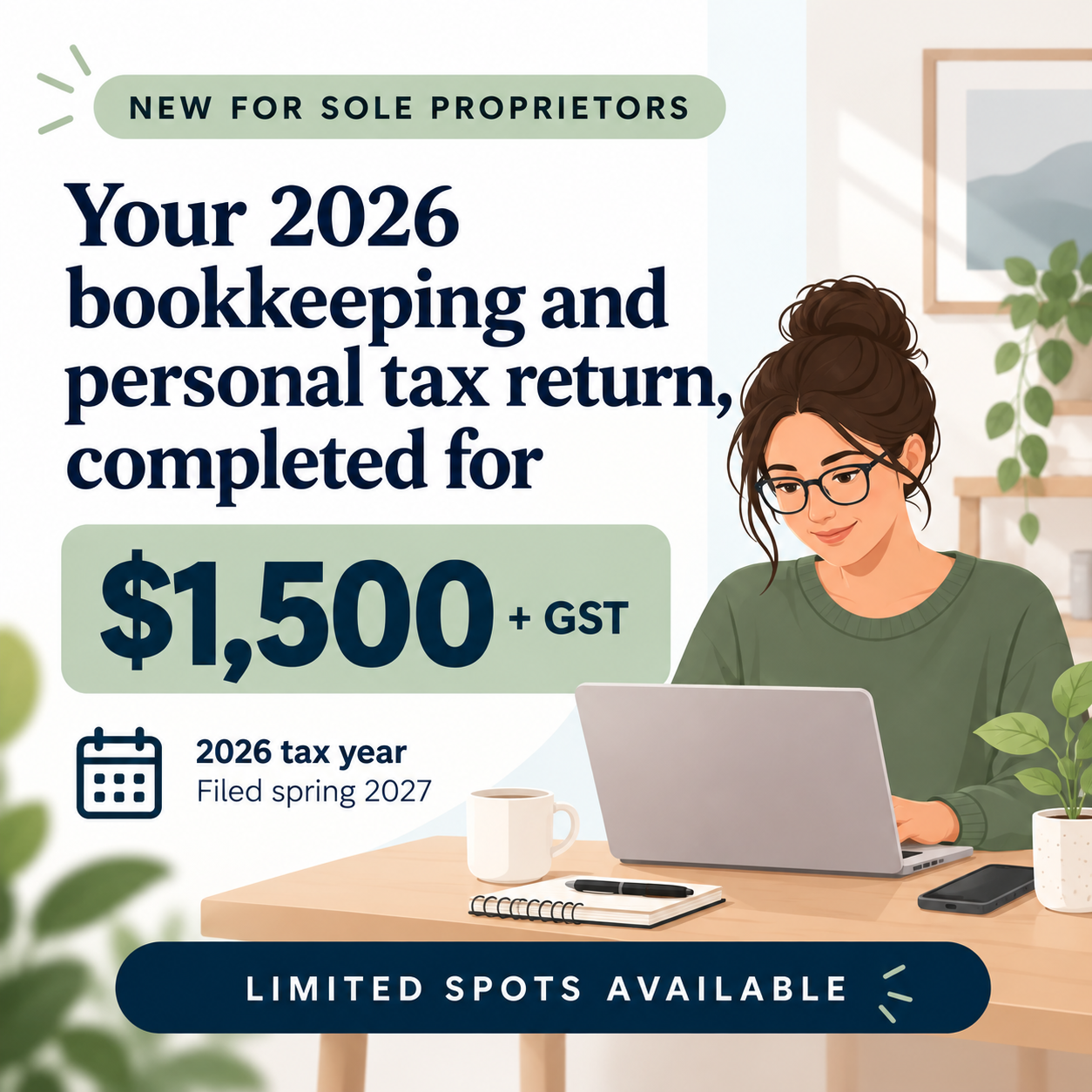
At Virtual Heights Accounting, we regularly hear from sole proprietors looking for bookkeeping help—often because tax time has arrived and they need to turn a year’s worth of transactions into organized information for their T2125, Statement of Business or Professional Activities.
For some businesses, monthly bookkeeping is absolutely worthwhile. For others, particularly straightforward sole proprietors who are comfortable preparing their own T1 tax return, the real need may be much narrower.
You might be perfectly comfortable using tax software such as TurboTax to prepare your personal tax return, including your T2125.
The problem is getting the bookkeeping done first.
So, what are your options?
Does a sole proprietor in Canada need a bookkeeper?
No. You don’t have to hire a bookkeeper simply because you’re a sole proprietor.
You are responsible for maintaining adequate records to support the income and expenses reported on your tax return, but you can maintain those records yourself.
Whether you should hire a bookkeeper is a different question.
Professional bookkeeping can be valuable if you have a large number of transactions, employees, inventory, significant accounts receivable or payable, more complicated GST/HST requirements, or simply don’t want to spend your own time maintaining the records.
But the needs of a straightforward service-based sole proprietor can be considerably simpler.
A consultant, photographer, therapist, contractor, coach or freelancer might have most of their business activity flowing through one bank account and a credit card.
For that person, paying for full monthly bookkeeping may be more service than they actually need.
Do sole proprietors need QuickBooks or Xero?
You also don’t necessarily need accounting software such as QuickBooks or Xero simply because you’re self-employed.
These are powerful accounting systems. They can help businesses with invoicing, accounts receivable, sales-tax tracking, bank reconciliations, financial statements and ongoing information about how the business is performing.
For incorporated businesses, we generally recommend maintaining proper accounting records in bookkeeping software throughout the year. Corporations generally have more complex accounting, tax and financial reporting needs, making an ongoing accounting system considerably more important.
But a straightforward sole proprietor can be different.
If you primarily need to organize your business activity so you can prepare your T2125 once a year, paying for accounting software every month—and learning how to use it correctly—may feel like an odd fit.
The question isn’t whether QuickBooks or Xero is good software.
The question is:
- Do you need an ongoing accounting system, or do you primarily need an efficient way to get your records organized for tax time?
Can you hire a bookkeeper just once a year?
Yes. Some bookkeepers and accounting firms offer annual or catch-up bookkeeping.
For many sole proprietors, this can be an excellent solution. You provide your records, the bookkeeper organizes the transactions, asks questions about anything that isn’t clear and provides you with the information you need for your tax return.
The challenge can be finding someone to do it—particularly at tax time.
We see this firsthand at Virtual Heights Accounting.
There is significant demand from sole proprietors looking for once-a-year or catch-up bookkeeping. We often have a waitlist for this type of work because our onboarding capacity is prioritized toward incorporated businesses.
We’re certainly not the only accounting or bookkeeping practice structured around recurring clients.
From a bookkeeping firm’s perspective, ongoing clients are easier to schedule and service throughout the year than a large volume of once-a-year files arriving during tax season.
That can leave a straightforward sole proprietor in an awkward middle ground.
You don’t necessarily need a monthly bookkeeper.
You may not need a full accounting system.
You may be comfortable preparing your own tax return.
But you still need to get from a year of transactions to the information you need for your T2125.
Can you do your own bookkeeping?
Absolutely.
For a relatively simple business, a spreadsheet may be all you need to organize your records.
You can download your bank and credit card transactions, work through them one at a time, identify the business transactions and categorize your expenses.
It’s inexpensive and gives you complete control over the process.
The downside is time.
Going through hundreds—or potentially thousands—of transactions manually can be tedious. You also need to make sure you’ve considered transactions that don’t appear neatly in your business bank account.
For example, you might have expenses paid personally, amounts owing to or from customers at year-end, business-use-of-home expenses, vehicle expenses or equipment purchases requiring additional tax treatment.
Most Canadian sole proprietors are also generally required to use the accrual method of accounting. That means bank transactions alone don’t necessarily tell the entire story.
Your bookkeeping needs to reflect the facts of your business, not simply the transactions appearing on a bank statement.
A different option: annual tax-prep bookkeeping software
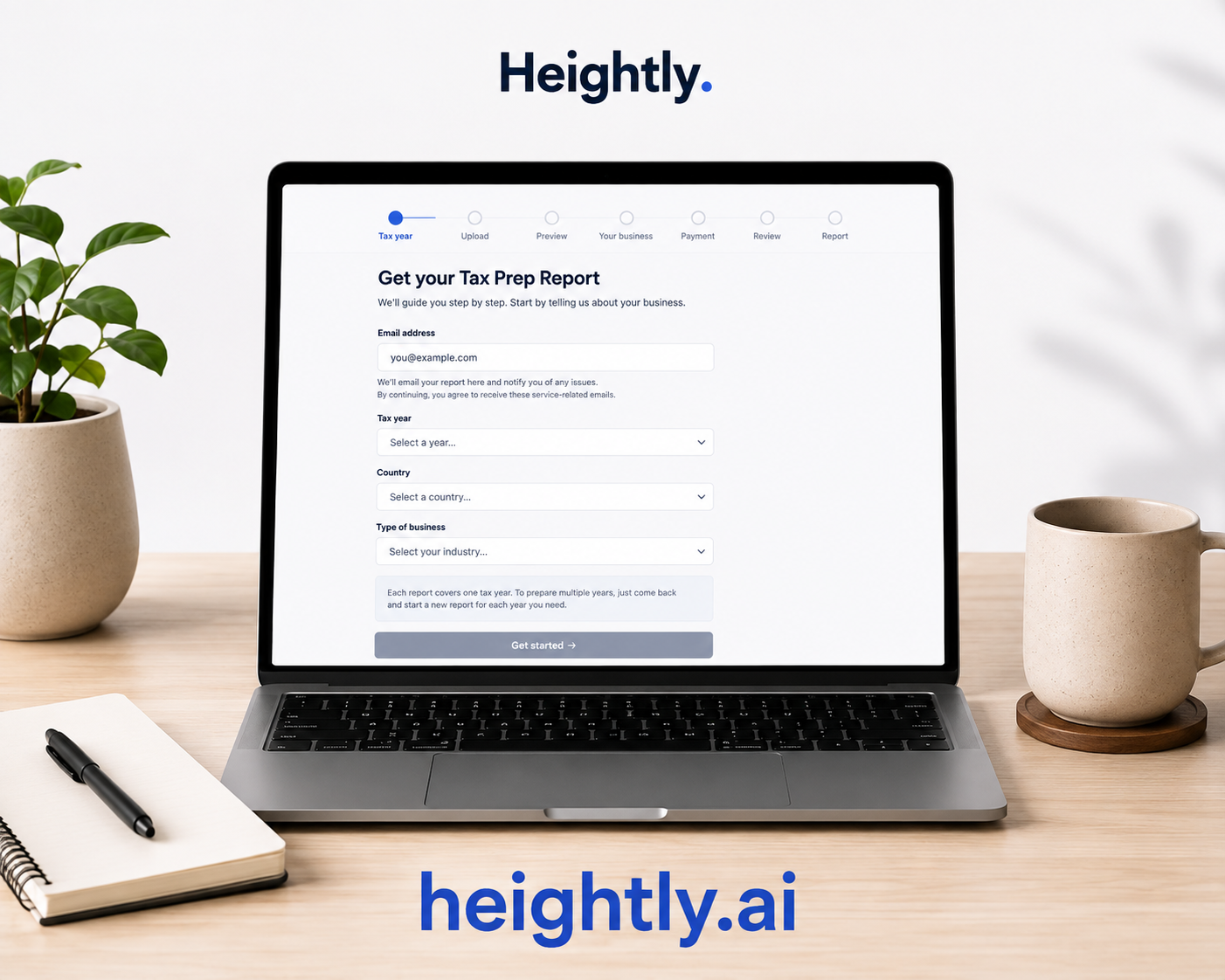
There is now another option between manually building a spreadsheet and maintaining a full accounting system throughout the year. And that is Heightly.ai.
A note about our relationship with Heightly
Heightly Software Inc. is a sister company to Virtual Heights Accounting. Both companies are under common ownership, and Alissa Bryden, CPA, CA, founder of Virtual Heights Accounting, has a financial interest in Heightly.We disclose that relationship because we think readers should know it when considering our recommendation.
Heightly.ai was created in part because we kept seeing this same problem:
Straightforward sole proprietors needed help organizing their records at tax time, but didn’t necessarily need—or want—monthly bookkeeping (including the monthly subscription fee).
What is Heightly?
Heightly is software designed specifically to help straightforward sole proprietors organize their financial records for tax preparation.
It is not intended to replace the ongoing accounting system we would generally recommend for an incorporated business.
It solves a much narrower problem:
You’re a sole proprietor. The year is over. Your bookkeeping isn’t done. You need to organize your records for your T2125.
Instead of subscribing to bookkeeping software every month, Heightly is purchased once per tax-year report.
You upload supported PDF or CSV bank and credit card statements. Heightly organizes the transactions into T2125-oriented categories and flags transactions that need your review.
Once you’ve reviewed your records, you can download PDF and Excel reports to help you prepare your own tax return or provide the information to your tax preparer.
There is also a free preview, allowing you to see how the process works with your records before purchasing a report.
Monthly accounting software vs. annual bookkeeping
There isn’t one right answer for every sole proprietor.
If you want current financial information throughout the year, accounting software and ongoing bookkeeping are valuable.
If you send invoices and need to track who owes you money, you may benefit from an accounting system. At Virtual Heights Accounting, our preference remains Xero Accounting software of which we are Gold Partners. However QuickBooks Online is another great option.
If you have employees, inventory, substantial accounts receivable or payable, more complicated GST/HST requirements, or a high volume of transactions, proper ongoing bookkeeping is likely the better approach.
And if you’re incorporated, our general recommendation is to maintain proper books throughout the year using appropriate accounting software.
But if you’re a straightforward sole proprietor who is comfortable preparing your own personal tax return and your biggest obstacle is turning a year’s worth of transactions into organized information for your T2125, you may not need all of that infrastructure.
You can:
- Hire a bookkeeper who offers annual catch-up work;
- Organize the records yourself using a spreadsheet; or
- Use a purpose-built tool such as Heightly to help organize the transactions.
You shouldn’t necessarily have to buy 12 months of bookkeeping software to solve a once-a-year bookkeeping problem.
Can you prepare a T2125 using only your bank statements?
Not necessarily.
Bank and credit card statements can contain a significant amount of the information needed to organize a straightforward business, but they aren’t a substitute for complete business records.
For example, your statements may not capture:
- Business expenses you paid personally;
- Income earned but not yet collected at year-end;
- Expenses incurred but not yet paid;
- Business-use-of-home calculations;
- Motor vehicle expenses and business-use calculations;
- Equipment and other capital purchases;
- Inventory;
- Certain GST/HST adjustments; or
- Other transactions that didn’t flow through the accounts being reviewed.
Your bank statement also doesn’t necessarily establish what you purchased.
A $300 transaction at a retailer might be a legitimate business expense—or something entirely personal.
Whether you’re using a bookkeeper, spreadsheet or software, you still need to maintain receipts, invoices and other supporting documentation and review your records for completeness.
Frequently Asked Questions About Sole Proprietor Bookkeeping in Canada
Do I need a bookkeeper as a sole proprietor in Canada?
No. A sole proprietor can maintain their own business records. Whether hiring a bookkeeper makes sense depends on the complexity of the business, the owner’s comfort level and how much time they want to spend maintaining their records.
Do I need Xero or QuickBooks if I’m self-employed?
Not necessarily. Accounting software can be extremely useful, but a straightforward sole proprietor may not require a full accounting system. The appropriate solution depends on what information you need from your books throughout the year.
Can I do my bookkeeping once a year?
For some straightforward sole proprietors, organizing their records annually may be practical.
However, annual bookkeeping isn’t appropriate for every business. Businesses that need current financial information or have more complicated transactions may benefit significantly from monthly or quarterly bookkeeping.
You also remain responsible for meeting any tax, GST/HST, payroll or other filing and payment obligations that arise throughout the year.
Can I do my own bookkeeping and file my own taxes?
Yes. Many sole proprietors maintain their own records and prepare their own T1 tax returns.
Tax software can help you prepare the return, but it doesn’t eliminate the need to determine the business income and expenses that need to be reported.
Bookkeeping and tax preparation are related, but they are not the same job.
What is a T2125?
Form T2125, Statement of Business or Professional Activities, is generally used by Canadian sole proprietors to report their business or professional income and expenses as part of their T1 personal income tax return.
Do I need bookkeeping if I use TurboTax?
You still need records supporting the business income and expenses you enter into your tax software.
Tax software helps prepare the return. It doesn’t necessarily do the underlying work of reconstructing and organizing a year’s worth of business transactions.
That’s why someone can be completely comfortable filing their own tax return and still need help with bookkeeping.
Can I just use my bank statements for my taxes?
Bank and credit card statements can be a useful starting point, particularly for a straightforward business, but they may not contain everything required to accurately report your business activity.
You also need to retain appropriate supporting documentation for the amounts reported on your return.
Finding the right level of bookkeeping
Bookkeeping doesn’t have to look the same for every Canadian business.
For corporations and businesses that rely on current financial information, we generally recommend maintaining complete books throughout the year using appropriate accounting software.
For some straightforward sole proprietors, the goal may be simpler: maintain appropriate records and efficiently organize the year’s business activity for tax preparation.
That might mean hiring a bookkeeper once a year.
It might mean maintaining your own spreadsheet.
Or technology may make the process easier.
If that last option sounds like your situation, you can learn more about Heightly and preview how it works with your own statements before deciding whether to purchase a report.
About Heightly
Heightly Software Inc. is a sister company to Virtual Heights Accounting. Both companies are under common ownership, and Alissa Bryden, CPA, CA, founder of Virtual Heights Accounting, has a financial interest in Heightly.
We disclose this relationship so readers are aware of it when considering our recommendation.
Heightly is a software product designed to help sole proprietors organize their financial records for tax preparation. It does not provide accounting or tax advice and does not prepare or file tax returns.
About the Author
Alissa Bryden, CPA, CA is the founder of Virtual Heights Accounting, a Canadian virtual CPA firm based in British Columbia. Alissa has worked with Canadian business owners for more than a decade and is also the founder of Heightly Software Inc.
Virtual Heights Accounting primarily works with incorporated Canadian businesses, providing corporate tax, accounting, bookkeeping and advisory services.
Disclaimer
This article was prepared by Virtual Heights Accounting for general informational purposes only and is not intended to provide accounting, tax, legal or other professional advice. The appropriate bookkeeping and tax treatment depends on the facts and circumstances of each business. Tax legislation and CRA guidance may change. You should consult a qualified professional regarding your specific circumstances where appropriate.