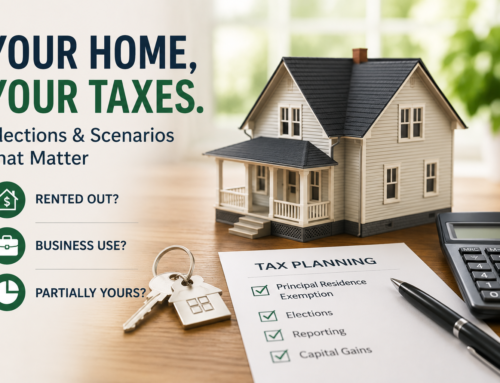

Rental income and capital gains can raise questions for homeowners who rent out part of their principal residence. Will renting a room mean you have to pay capital gains tax when you eventually sell your home?
I recently came across this exact question in a community Facebook group.
Someone had heard that if you rent out part of your principal residence, you could end up paying capital gains tax when you eventually sell your home. Their reaction was understandable: if that’s true, doesn’t that discourage homeowners from creating much-needed rental housing?
The good news is that the tax rules aren’t quite that simple.
In many cases, renting out a room or a relatively small part of your home does not mean you automatically lose the principal residence exemption.
CRA has an important exception
Normally, Canada’s change-of-use rules can apply when you start using part of your home to earn income. In some cases, this can affect how CRA treats that portion of the property for capital gains purposes.
However, CRA has an important administrative position for homeowners. It applies when the rental use remains secondary, or ancillary, to the main use of the property as your home.
CRA will generally consider the entire property to continue to be a principal residence where all three of the following conditions are met:
- The income-producing use is ancillary to the main use of the property as your residence;
- There has been no structural change to the property to make it more suitable for rental or business purposes; and
- You have not claimed capital cost allowance (CCA) on the property.
The CRA specifically identifies renting one or more rooms in your home as an example where these conditions may apply.
A simple example
Suppose you own a three-bedroom home and live there as your principal residence.
You decide to rent a spare bedroom to a student, without renovating the home to create a separate rental unit or claiming CCA on the property.
The rental income still needs to be reported. A reasonable share of eligible expenses related to earning that income may generally be deducted.
However, collecting rent does not automatically mean that 20% or 30% of your future gain becomes taxable.
If the rental use remains ancillary and you meet the other conditions, CRA may continue to treat the entire property as your principal residence.
Where things can get more complicated
The answer can change where there has been a substantial and more permanent change in use, particularly where structural changes have been made.
CRA specifically discusses situations involving structural changes, including converting part of a house into a self-contained rental unit such as a duplex or triplex.
In those circumstances, there can be a partial change in use of the property. That can result in a deemed disposition of the affected portion at fair market value and ultimately mean that some of the gain associated with the rental portion is not sheltered in the same way as the principal-residence portion.
There are also elections available under the Income Tax Act that can affect the result in certain partial change-of-use situations, so this is an area where the details matter.
Be careful with CCA
One of the most important considerations when renting out part of your principal residence is capital cost allowance (CCA).
CCA is Canada’s tax depreciation system and can sometimes be claimed on the building used to earn rental income. However, CRA’s administrative position allowing the entire property to retain its nature as a principal residence specifically requires that no CCA be claimed on the property.
In fact, CRA states that if a taxpayer begins claiming CCA after the rental use has already started, the partial change-of-use rules can apply back to the time the income-producing use originally began.
For someone renting a room or an ancillary portion of their home, claiming CCA simply to reduce current rental income can therefore have much broader tax consequences and should be considered carefully.
You can still deduct rental expenses
Not claiming CCA doesn’t mean you can’t deduct any expenses.
You can generally deduct a reasonable portion of eligible expenses related to earning your rental income. Depending on the circumstances, these may include:
- Property taxes;
- Utilities;
- Home insurance
- Certain repairs and maintenance.
The allocation needs to be reasonable. CRA notes that factors such as the number of rooms or the area of the home can be used when allocating expenses.
The rental income still needs to be reported even if the entire property ultimately continues to qualify as your principal residence.
So, does renting part of your home create a capital gains problem?
Not necessarily.
If you’re simply renting a room or an ancillary portion of the home you continue to live in, haven’t made structural changes to create the rental space, and haven’t claimed CCA, CRA’s administrative position may allow the entire property to retain its nature as a principal residence.
That doesn’t eliminate the normal principal residence exemption requirements, but it means that simply earning rental income from part of your home does not automatically cause that portion of the property to become taxable when you eventually sell.
If you’ve created a separate rental suite, substantially converted part of the property, claimed CCA, or changed a significant part of the property’s use, the analysis becomes more complicated.
So before deciding that renting out your spare bedroom is going to create a huge tax bill when you sell—or before claiming CCA to save a little tax on this year’s rental income—it’s worth understanding which rules actually apply to your situation.
This article provides general Canadian tax information and is not intended as tax advice. Principal residence and change-of-use rules are highly dependent on the particular facts and circumstances.
About the Author
Alissa Bryden, CPA, CA is the founder of Virtual Heights Accounting, a Canadian virtual accounting firm based in British Columbia. Alissa has been helping Canadian business owners navigate corporate tax, accounting and financial decisions for more than a decade.
Virtual Heights Accounting works primarily with incorporated small and medium-sized businesses across Canada, providing corporate tax, accounting, bookkeeping and advisory services.
Learn more about Virtual Heights Accounting at vhaccounting.ca.