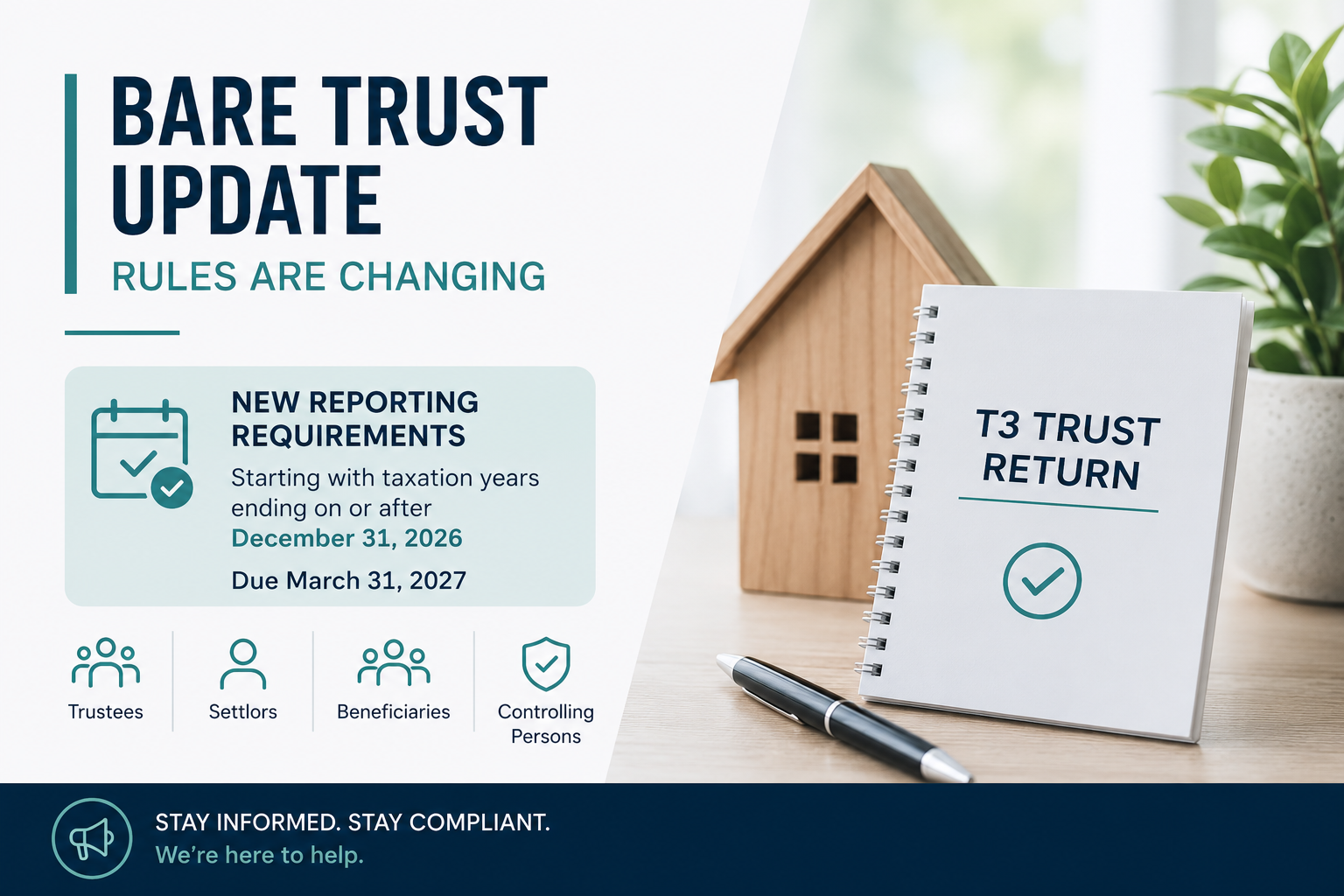
The trust reporting rules have changed several times in recent years. Bare trusts were technically included in the enhanced reporting rules for the 2023 taxation year, although the CRA did not require them to file unless it made a direct request. Bare trusts are not subject to the enhanced reporting rules for the 2024 and 2025 taxation years. Beginning with taxation years ending on or after December 31, 2026, certain bare trusts will be subject to reporting rules. On March 26, 2026 Bill C-15 received Royal Assent and amended trust reporting within the Income Tax Act.
Where an exception is relied upon, the trustee should retain sufficient documentation to support the conclusion that all applicable conditions were met. The CRA may request supporting documentation or formally require a T3 return to be filed.
More information is also expected to be released before the 2026 T3 season. The information in this blog is from early releases and is meant for general information. Ensure you speak with your accountant regarding any item you are considering exempt from filing that would have otherwise met the criteria of a bare trust (defined below).
What has changed?
Certain bare trusts will be required to file for taxation years ending on or after December 31, 2026, due March 31, 2027 (90 days after December 31, 2026).
Notably, Schedule 15 of the T3 return requests specified information on “reportable entities” of the trust, including all trustees, settlors, beneficiaries, and controlling persons of the trust. The following is required for each reportable entity of the trust:
- Name,
- Address,
- Date of birth (if an individual),
- Country of residence, and
- Tax identification number (i.e., SIN, BN, TN, or ID number used in a foreign jurisdiction).
Note: Bare trusts are not subject to the enhanced trust reporting rules for the 2024 and 2025 taxation years. For the 2023 taxation year, the CRA did not require bare trusts to file unless it made a direct request.
What is a bare trust?
In a bare trust, there’s a separation of legal and beneficial ownership. Although the property is registered under the trustee’s name, the beneficial owner has the rights and attributes of ownership over the property (possession, use, risk, and control).
A bare trust can be a formal agreement or an implied setup, but are always where the trustee acts as an agent for the beneficiaries under the trust. A trustee is reasonably considered an agent when the trustee:
- Has no significant powers or responsibilities,
- Cannot take action without instructions from the beneficiary, and
- The trustee’s only function is to hold legal title to the property.
Where, the trustee’s only duty is to transfer the asset upon the beneficiary’s demand.
Arrangements that May Involve a Bare Trust
An express bare trust is typically in a written agreement or deed and created deliberately. For example:
- Pre-construction property assignments,
- Corporate nominee in real estate, and
- Holding/Operating company restructuring.
However, you might not realize you’re involved in a bare trust arrangement.
An implied bare trust arises from intention and action, rather than formal agreements.
The following arrangements may involve a separation between legal and beneficial ownership, but none automatically creates a reportable bare trust. Each arrangement must be reviewed based on its documents, the parties’ intentions, their conduct and the applicable provincial or territorial law.
Here are a few examples:
- A truck registered in an individuals name but owned by their corporation:
An individual and a corporation are two distinct legal entities. If the truck is registered in an individuals name for the corporation the corporation is paying all related expenses and writing off the asset via capital cost allowance. It was
- Joint bank accounts for estate planning:
- An adult child is added to a non-registered investment account or bank account for an aging parent with the intention is to simply pay bills and manage funds – the child does not own the money and is acting as an agent.
- Spousal property titling:
- Only one spouse’s name is on the legal title, due to credit history at time of purchase, but spouses jointly acquire and occupy the home. A portion of the property (or all of it, depending on the facts) may constitute an implied trust arrangement for the spouse not on title.
- Co-signing a mortgage:
- A young adult doesn’t qualify for a mortgage, and the parent has co-signed to meet the lending requirements. Without contributing to the mortgage payments or down payment, they have no beneficial interest in the property.
Whether a particular arrangement is a trust, a bare trust, an agency relationship or genuine joint ownership depends on the legal documents, the parties’ intentions, their conduct and the private law of the applicable province or territory.
Are there exemptions to bare trust filings?
The legislation contains several exceptions, and the CRA has indicated that further guidance will be provided before the 2026 filing season. Existing listed-trust rules also include exceptions for certain trusts with property valued at no more than $50,000 throughout the year and certain related-person trusts holding specified assets valued at no more than $250,000 throughout the year. Each condition must be reviewed carefully.
For example, under Bill C-15, certain bare trusts may not be required to file a T3 return, including but not limited to the following arrangements:
- All legal owners are also beneficiaries (and vice versa),
- One spouse is on title, and the property is a shared principal residence,
- A parent is on title for a child’s principal residence (lending support only),
- Joint bank or investment account between spouses or common-law partners, and
- Total trust assets are under $50,000 in fair market value during the year.
However, certain bare trusts are considered “reportable bare trusts,” not included on this exempt list, and required to file T3 returns; including:
- Multi-generational secondary properties and rental properties:
- Where relatives such as parents, aunts, and uncles are named on the deed as legal owners of rental or investment properties (not exclusively the principal residence of the child), and
- Investment accounts for children over $50,000.
Consider some of our examples above
Vehicle Held in a Corporation
If the vehicle was less than $50,000, then that exemption would apply. If not, then the other exemptions should be reviewed but there may in fact be a reporting requirement. The recommendation would be to review and consider if transfer from the individual to the corporation (correct owner) is recommended to prevent further reporting requirements. All individuals should check ownership on there registration and bring discrepancies to their accountant. PST charges may apply on transfer of the vehicle depending on location.
Adult Child Added to a Parent’s Account
An adult child may be added to a parent’s bank or investment account for convenience, estate planning or assistance with bill payments. This does not automatically mean that a bare trust exists or that a T3 return is required. The arrangement must be reviewed to determine whether the child is an agent, a legal owner without a beneficial interest, or a genuine joint owner. Relevant factors include the account documentation, the source of the funds, who uses and controls the funds, the parties’ intentions and their actual conduct.
The strongest protection for a client in this situation is documentation: a simple letter or memo of understanding signed by both parties stating the child’s role is solely administrative and that the parent retains full beneficial ownership. That documentation, combined with a clean account conduct (no child-benefit withdrawals, no child deposits), is what makes an exemption defensible if reviewed by CRA.
Other Examples: There are many other examples of possibly bare trust relationships that may require reporting. Check out this information release from the CRA for more information: https://www.canada.ca/en/revenue-agency/services/tax/trust-administrators/t3-return/filing-trust-return/what-changed.html
Ensure you also bring your notes on possible impacts and situations where this may be applicable to your accountant for discussion.